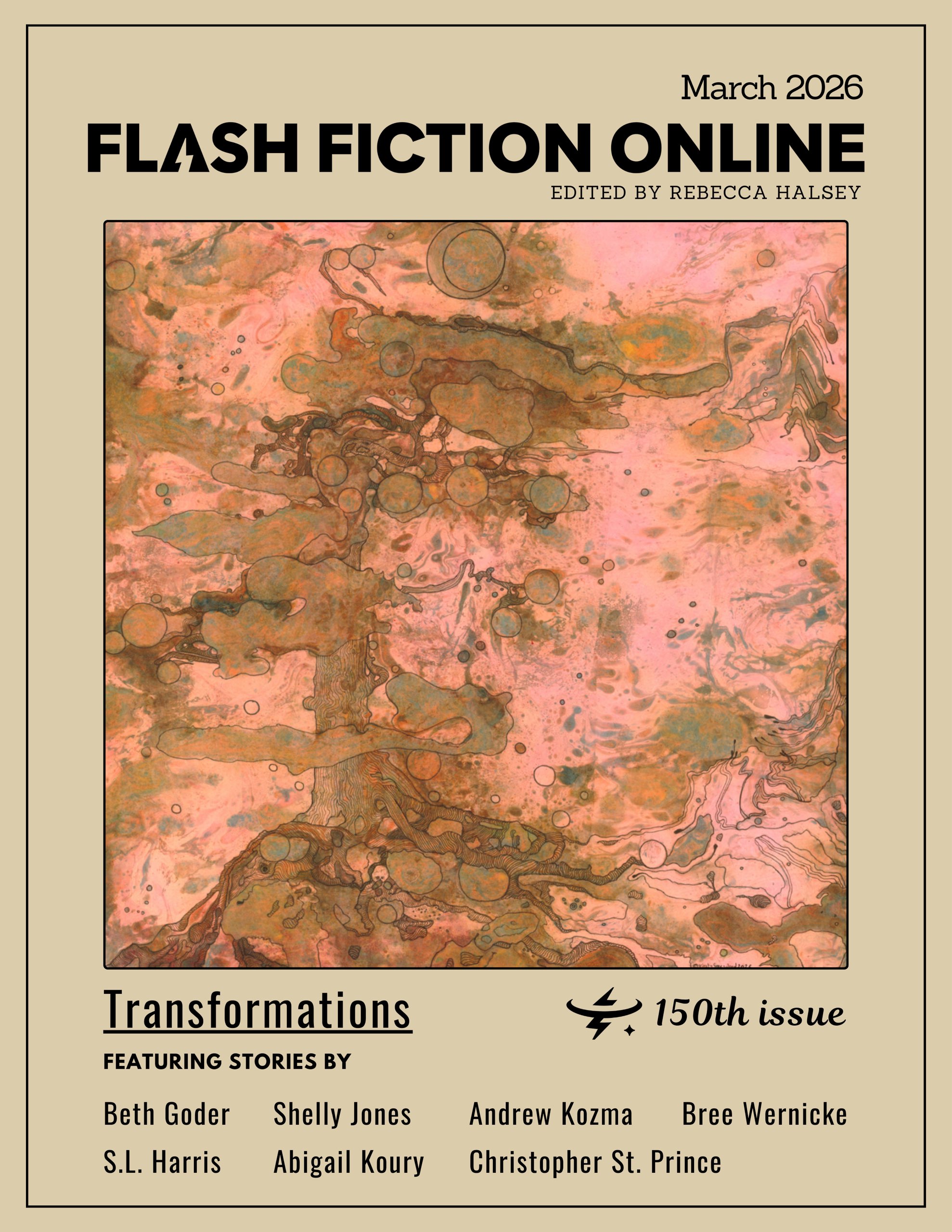
Issue 150 March 2026 Transformations

Table of Contents

Transformations: 150 Issues & Counting!

by Rebecca Halsey

March 1, 2026

Editorial

Don’t you wish you could be like water? With all its states of matter…? It would be so convenient to have a liquid, solid, and gas form. We contain flesh, blood, and breath, of course. But, it would be lovely if we could utilize states of matter in a more transformational fashion.

Sick of your failing meat sack? Become breath and dissipate for a while. Tired of being blown about on the wind? Form clouds, and rain yourself upon the earth. Buffeted by psychic or physical attacks? Solidify, tighter and tighter, until you are bedrock. Fight, flight, freeze, fawn… TRANSFIGURE!

This month, we are celebrating transfigurations. As a magazine, we are excited to be releasing this 150th issue, and over the course of 150 issues we have changed. We’ve had multiple editors-in-chief, countless volunteers, at least a couple publishers. I’m but the latest in a line of fiction aficionados.

Since inheriting this magazine, I have dreamed of achieving all states of being that a magazine can have—print and audio, while keeping our digital roots. First step has been to update our home base, our website, the look-and-feel, but also the backend content management system. For over a year, we’ve been working with the Dapper + Associates design firm out of Seattle, WA, to achieve this transformation. This month, we will be doing the final migrations and launching it all.

I am beyond excited! And couldn’t think of a better way to celebrate than to assemble stories that viscerally describe changes in a state of being. We have two astonishing, space-based transformations—“Moss Senses” by Beth Goder and “Moonmouse” by S.L. Harris.

Of course, not all of transformations are peaceful. Andrew Kozma’s “The Sacrificials” offers a chilling reflection of how collective horror is justified. “The Piano Made of Fingers” by Abigail Koury gives us a physical representation of a teacher’s indoctrination of a student.

Some transformations can’t be undone, as we see in “Second Film” by Christopher St. Prince.

Some are done privately, among family, as in “Float. Sink. Tread. Swim.” by Shelly Jones. And, some—like our own—can only be unleashed upon the world, much like we see in Bree Wernicke’s “The Oil King.”

Each of these stories will be released over the course of the month, in our usual fashion. As we move to the new website, you can follow along with us by checking our social media accounts: Facebook, Threads, Instagram, and Bluesky. Or, by becoming a follower on Patreon. We hope you enjoy watching our transformation!

* * *

Rebecca Halsey

Leave a Reply

The Sacrificials

by Andrew Kozma

March 3, 2026

Horror

When the sacrificials come through, the entire city shuts down, fireworks filling the night sky and music booming out from hastily set-up stages. The atmosphere is ecstatic, the way the tongue glories in the final meal before an execution. It’s Mardi Gras without the religious veneer. And you might as well join the party, because sacrificials can walk through walls and turn houses to smoke with a touch. For Madsen, the sacrificial parties are the worst part of urban living.

Madsen would rather run. The first mention of sacrificials on socials, she gets on her scooter and goes. The vehicle is small enough to weave around traffic jams and roadblocks, able to make it to a motel or campground far enough away to be safe.

Except last night, Madsen stayed over with a new guy she’s dating. He asked her to switch off her phone, so they could really “be together” and she gave in, because it’d been a long time, and she was lonely, and didn’t want to fuck up whatever this was before it even started. When she woke, he was gone, no note, much less breakfast. She turned on her phone to the news trumpeting the sacrificials’ arrival.

The streets are already clogged with people. Her scooter, her only chance to escape, is across town.

Madsen hurries down Westheimer, weaving through the crowds of the dancing, the drunk, and the desperate. Broken glass glitters like diamonds. Sections of the sidewalk glow like rubies from the blood of those fallen from fights or drunkenness. The police have stripped off their uniforms because they aren’t needed. Their fear gives them away; brighter than most, it’s the fear they’ll come face to face with a sacrificial, be tapped with a calm finger and disinterested stare, and forced to reckon with being just another common citizen.

A snaking frat bro chain of revelers pushes an old man carrying groceries to the ground, smashed eggs and spilled milk spreading in a puddle beneath him. Madsen reaches down to help, but he turns to her with horror.

“Don’t touch me!” he yells.

Madsen recoils. A handful of the man’s face has been scooped out like clay, the tracks of individual fingers molded into what’s left. Pulling his leaking bag of groceries to his chest, he scuttles away through the crowd.

Half a block later, Madsen grabs a drink from a fold-out table and downs it in one go before grabbing another, the tall black man behind the makeshift bar waving away her attempt to pay.

“We’re all in this together,” he says, smiling a sad smile.

That second drink is already gone. A scream and she turns to see a woman ribboning into the air, a sacrificial spinning out the skin into the sky. The crowd tides away. Madsen runs.

* * *

Her hometown in Virginia almost destroyed itself when the sacrificials came through, people rioting after an entire pre-school class met a sacrificial on a day trip. Buildings were left to burn into ash. Urgent care centers locked their doors. After a week of terror, everyone acted as if nothing had happened. Madsen’s friends adopted their parents’ attitudes, changing the subject whenever she mentioned what had happened. Madsen couldn’t sleep for the nightmares. New buildings replaced the old like badly-sewn stitches. Those twenty children the sacrificial touched were rooted into the ground, heads pointed at the sky, screaming mouths frozen open. No one tended to them. Birds pecked at their eyes.

Politicians and priests say it’s bad luck to run. They say the sacrificials prevent famine, stop war, shield us from disease. For the good of everyone, some have to be sacrificed! And so, the government encourages these celebrations, funneling money in afterwards for recovery. They can’t do anything to stop it, so why not co-opt it, claim it was beneficial?

* * *

A street preacher looms atop a trashcan at the intersection of Westheimer and Hazard, his litany of sin and repentance occasionally interrupted with a thrown bottle or dixie cup of wine. Women on the edge of Empire Café’s roof toss water balloons into the crowd. One bursts near Madsen’s feet, the smell of vodka stinging her nose. She eagerly breathes it in. Every face around her is stretched into a smile under pupils dilated with drugs.

She understands the instinct, all this. What you can’t avoid, you might as well embrace. Look forward to. Pretend to enjoy. See as a blessing. Something meant to be. An inextricable part of your life. Formative, even.

Madsen understands it, but can’t embrace it. She needs to get home, get her scooter, get out. None of this needs to happen. Giving in to these infected humans, these fallen gods, these natural disasters made flesh. We don’t have to roll over and offer ourselves up as victims to a process those in power don’t understand and refuse to protect us from.

She forces her way through people in bathing suits doing shots only to find herself in a growing circle of quiet. The city’s frantic celebration rages on, but it’s muted here. Her heart pounds like she’s been sprinting for blocks, her breathing ragged and shallow. Scattered across the emptied street in front of her are just a handful of people. They shimmer like heat mirages. They move like dripping blood.

Sacrificials.

To Madsen’s right, a sacrificial man murmurs into a woman’s ear with the sound of an industrial vacuum and she won’t stop screaming, her skull expanding away from his lips. Across the street, a man’s legs unfold endlessly under an old woman’s fingers. Madsen steps back, but a solid wall of bodies blocks her, and now a sacrificial woman is in her face, eyes shrunk to potato pits, mouth open, mouth a night sky, mouth a constellation of broken teeth, and somewhere in there a north star Madsen is meant to follow.

It is too late to run.

The woman’s fingers circle her wrist.

The changes have already begun.

* * *

Andrew Kozma

Leave a Reply

Moss Senses

by Beth Goder

March 6, 2026

Science Fiction

Sense of Touch

Bryo is a moss-covered planet. A world of milky softness, cool as water, submerged in green.

When Agata steps out of the spaceship, she sinks into moss up to her knees. Moss clings to her legs, full of softness, gifting her a gentle chill. With a fierce push, she rejects this indulgent touch, pulling back like a tiger slipping out of a cage, because she needs to search for the others.

* * *

Sense of Sight

Agata examines the area around the spaceship, then looks to the horizon, to the oceans of moss that scream in green.

She searches for Finola’s red hair or the curve of Viktor’s shoulders, but they are gone, swallowed.

Moss rushes up Agata’s legs. Cowers in the crooks of her fingers.

* * *

Sense of Smell

It smells like rain, although it hasn’t rained. It smells like earth, although she is so far from Earth.

Finola and Viktor made her promise not to leave the spaceship, but it’s been weeks. She can’t abide the sterile environment of the ship, the way it smells like nothing human, just wisps of disinfectant and metal.

She came out here to find them, because the only other option was to abandon them.

* * *

Sense of Taste

The moss tastes fishy and bitter, like an unfortunate salad.

She doesn’t know how it got into her mouth.

It coats her tongue. Slithers down her throat.

She remembers last night’s dream, where she baked a cake and threw away her whisk. The cake was flavored with oranges, too sweet, but she woke up craving that saccharine taste.

* * *

Sense of Hearing

The moss doesn’t use words to speak. What she hears are not words, but impressions. The moss wants to understand her dream. What is a whisk? Why did she throw it away?

“Where are they?” Agata asks, but her mouth is still coated in moss.

* * *

Sense of Fear

If the moss can sense her dream, what else can it sense?

Her heart beats in twin gasps. Her breath is a razor in her throat.

“Don’t be afraid,” says the moss.

* * *

Sense of Belonging

“We know how to love you,” says the moss. “We have made a space for you.”

Is it wrong that a part of Agata wants to believe the moss? To let it envelope her? Isn’t this what all humans want—to belong? She once saw a tiger at the zoo, and she thought, “I am like that tiger. I need a cage to myself. Who else would want my squalid heart?”

She’d craved a sense of belonging with Finola and Viktor. Tried so hard for it. Made breakfast every morning, whisking pancakes. Whisking eggs for scrambles.

“It’s not that they don’t love you,” says the moss. “It’s only that they were missing an important sense.”

* * *

Sense of Proprioception

“Take me to them,” Agata says.

The moss guides her, and she glides over the squelchy terrain of Bryo. Or perhaps the moss moves her. It’s hard to tell what parts of her body are still entirely hers. She senses the position of her arms, her legs. She feels the moss move inside her like bits of clouds she’s swallowed.

* * *

Sense of Duty

As she walks, she rejects thoughts of duty, moral obligation, or what she owes to her crewmates. Instead, she thinks of the etymology class where she learned that an obsolete meaning of “duty” is “debt.”

The moss looks on, inside her head, curious about the duplicitous nature of language.

* * *

Sense of Trust

At the bottom of a hill, she finds her crewmates outlined in green.

Finola and Viktor are more moss than human, but she recognizes their voices.

“The moss is teaching us,” says Finola.

“This won’t hurt,” says Viktor.

* * *

Sense of Compassion

The moss shifts inside her, gifting her with a new sense—it feels as if eyes are opening all over her body and there is so much light.

She sees Finola and Viktor in all their human complexity. Their egos and fragility and astonishing virtues. Their deficits and desires and stratified histories. Their squalid hearts.

Last night, Finola dreamt of oranges, of peeling each one in darkness. Viktor dreamt of a wide sea, which swallowed him, his terror and joy compounded.

Agata knows everything they can remember. Every dream. Every thought.

* * *

Sense of Peace

The moss is here between them, with them. There is a promise of serenity, of total acceptance.

Green creeps over her eyes, into her ears, so cold and crisp, with a salt tang that weeps into her mouth.

Her crewmates wait for her to join them.

Nothing is hidden.

Finola’s inner voice sounds like an orange being peeled; her mind is layered and in it Agata can see every last longing. Viktor’s mind behaves like an ocean, wave after wave beating against the shore, and all his darkness is contrasted by so much light. There is something too beautiful about the way his mind curls around like a spiraled shell.

Everything is open to Agata. Everything they have ever felt. Every sense.

* * *

Sense of Self

Agata doesn’t know if she can accept what the moss is offering. Not everything needs to be whisked together like so many broken eggs.

* * *

Sense of Interoception

‘Will you let me go, if I ask?” says Agata.

Inside her body, she senses a tightening and loosening.

I am a tiger, she thinks. But it is so tempting, to open up her squalid heart, to stay.

* * *

Beth Goder

Comments

  1. Brian Yanish says:
    Lovely evocative sense of the soft yet confining properties of a living ecosystem. And by giving up ourselves to a collective what do we gain and lose? And why do we have to see it that way/

Leave a Reply

The Piano Made of Fingers

by Abigail Koury

March 13, 2026

Horror

With her limited school budget, Ms. Kaplan went to Marl’s Boutique of Magnificent Sounds where the clerk led her to a piano made of fingers. She played some notes across several octaves to test it out. Some of the lower keys stuck a bit, but it would be manageable. It was a well-loved piano. The white and black fingers had grown wrinkled and stiff. The few, new, supple, young fingers—must be a recent repair by the store—stuck out like the bright young children at the decrepit school.

Ms. Kaplan showed the music club the basics of how to play this instrument. Sarah, Beatrice, Violet, and Grace crowded around the piano with Angela and Dahlia hanging back.

“Place your fingers in between the knuckles for proper grip,” Ms. Kaplan told Sarah.

Sarah adjusted her position and pressed down on a few wrinkly keys, experimenting. The students giggled at the noise. It was powerful with even the lightest touch.

“What happened to the old piano?” Dahlia asked from the back. “What happened to its fingers?”

It decayed like all things, Ms. Kaplan thought, but she told the class, “We gave it away and upgraded to this. Doesn’t this sound better?” Sarah continued playing and none could argue the new piano wasn’t an improvement.

Sarah was the student who needed hardly any instruction. She had never played before but was a natural. Ms. Kaplan might finally get to use her free time to teach some actual music in this after school club, something beyond the basics. But Sarah also excelled at Finance, Managerial Benevolence, The Hierarchy of Faces, Fabrics, Harvest, and Fervor, like any good girl should.

And so it wasn’t Sarah who took to the piano’s charms, but Dahlia.

Dahlia was shy and so the other students assumed she was extra smart and learned things in private sessions where she got ahead of everyone. But when she spoke, everyone laughed at how blunt and basic her speech was. She wasn’t any dumber than average, she simply had a speech impediment. She was a victim of raised expectations brought about by her silence.

Ms. Kaplan found Dahlia lingering with the piano after the rest of the club left. Dahlia approached to see some of the fingers were dry. She used her own lotion to rejuvenate the keys, to ease the pain of prolonged exposure without moisture. Then she began to play.

Dahlia played loud. The timbre of her playing had the snap of bones with the warmth and ache of still living skin. Clair De Lune never sounded so warm or curious. Many professional piano players struggled to get the fingers to stay in tune with each other, as they often strained to escape the instrument, but Dahlia had a way with them.

Ms. Kaplan was pleased with what she heard and made sure to splurge and buy some fresh fingers from the premium market on her way home.

With fresh digits, the piano only sounded better, and Dahlia was happy to see a teacher take interest in her, since she was struggling in Finance and Fervor. Dahlia worked hard and wrangled the piano for every performance. She also put her own feelings into it. It was all going well enough that Ms. Kaplan would soon be able to plan a recital and, if received well, perhaps get music put onto the official curriculum. It might have happened if Dahlia didn’t make the same mistake as before: opening her mouth.

“Where do the fingers come from?” Dahlia asked.

“No. We don’t ask questions here.” Ms. Kaplan said gently.

“I’ve been having dreams ma’am. I think I already know.”

“Then you know you need to stop chasing that idea.”

“It’s cruel. It’s unfair. I won’t do it.” The words seemed righteous, but she sniffled through her little rebellion. This was the problem with finding musicians. They were either so un-attuned to emotion as to only produce passable noise, or they were so sensitive that the entire operation put them off.

“You’re the first of your family to attend school, correct?” Ms. Kaplan asked.

“Yes.”

“Leave it to the third generation to question the bigger things. They’ll have the resources to weather it. For now, you may use this.” She handed Dahlia a blindfold.

And so training began in earnest. Dahlia had to wear the blindfold 24/7, like all students who had found their Focus. During the day, they trained with a plastic keyboard with sleek, but tough, mannequin fingers. At night, the blindfold dampened Dahlia’s pesky dreams, so that the massive, liquid feeling of gnosis was kept at bay to allow her to adequately prepare for her big performance.

Dahlia performed beautifully at the recital. Backstage afterwards, as Ms. Kaplan waited to congratulate her, she observed Dahlia removing her blindfold to see her adoring family.

Her younger sister screamed. Her parents flinched. The teachers, although they would later deny it, recoiled as they had never seen a student whose Focus was music. They didn’t know the risks. When Dahlia put together what had happened she sobbed . Ms. Kaplan was there to comfort her and offer coping methods for her new way of seeing with her eyes made of newly grown fingers, knotted and stuffed into her sockets, squirming and desperate to touch.

Dahlia, unwilling to grow into her Focus, dropped out of school to convalesce. And so Sarah became the star piano player. But Sarah wasn’t as sensitive or interested in the art form, so she used her musical skills as a resume builder and Focused on the Hierarchy of Faces, just like each member of her beautiful family.

Ms. Kaplan shook away the doubt that no child would have the perfect temperament to flourish under her tutelage as she fastened a tarp over the piano and locked the room up for the summer, leaving the fingers confused, restless, and alone.

* * *

Abigail Koury

Leave a Reply

Float. Sink. Tread. Swim.

by Shelly Jones

March 17, 2026

Fantasy

CPS is at the door again when Oma begins her change. She’s lying in the tub, curlers pinned to her scalp, and I can hear the faint bossa nova beat of her favorite Rosemary Clooney record playing. 

“Should I answer it?” I ask through the cracked bathroom door. Scales drop from her skin and clog the drain as she tries to climb out. There’s a crash of water as she collapses back into the tub, fins slipping against the porcelain. “You’re right – they’ll come back later.” The record spins idly and I wait in the darkened living room, ignoring the doorbell, until she’s ready to come out. 

Oma has not mastered her transformation yet. Unlike her sisters, she has no control over her body. Spiny rays sprout along her neck at inopportune times – in line at the supermarket or at my Spring concert.

Oma says one day I will go through the change as all of the aunties did, as my mother did before she died. At night I lay in my bed and feel my skin pucker, but no scales surface, no gills slit my cheeks. I am both ashamed and relieved.

* * *

Oma has never believed in church, eyeing the priests and their baptismal pool suspiciously. But she went when my mother was married, and again when she died, even though she knew it would do no good. The aunties sat with us, holding on tightly to Oma so she would not change even when the holy water grazed her forehead. The other mourners assumed the aunties were keeping her upright so she wouldn’t collapse in a heap of tears. The other mourners did not know my mother or our family’s story.  

When she was a child, the revivalists tried to rid Oma of her affliction. She doesn’t speak of it, but sometimes when she’s washing dishes I see the marks on her wrists where the chains held her fast in the flame. But fire was never Oma’s path. The aunties told me the story once, when we lost Oma in the swamp after my mother died. As we searched through fern and sedge, cattail and water lily, the aunties remembered how the revivalists claimed they could cure anything. Oma’s parents were tired of having “special” daughters, daughters that could change without their permission. As the eldest, Oma was cast first. But when they watched the flames lick her body, tears jelling in her wide eyes, her parents relented. The aunties doused the fire and dragged Oma to the creek, where her charred skin sank into the mud. Her parents never spoke to Oma again, shame stiffening their tongues. I watched the aunties cry for the first time when we finally found Oma curled against a cypress, scales pimpling her skin, that same look of horror paralyzing her.

* * *

The CPS officers are back. They look me over, as though I were a boar at a county fair. “No lice, no bruises, has all her teeth,” one checks off a list. The state awarded Oma custody when my mother died, but the judge was suspicious of her eccentricities – the way she twitched in the courtroom, unable to make eye contact – and required check-ins by CPS for the first six months.

“Where’s your grandmother?”

“In the bathroom. Dinner didn’t agree with her,” I say, hoping they’ll just leave.

I can feel Oma sinking deeper into the water, as if wishing she could wriggle down the drain pipe, escaping this humiliation. She worries she’s a bad Oma; she isn’t. She roils at even the suggestion of impropriety.

“Tell your grandmother we hope she’s feeling better and we’ll see her next month.”

Even from the living room I can feel the waves of embarrassment wash over Oma as the CPS officers leave.

* * *

I pull out a map and spread it across a pool floatie. Oma lounges in a checkerboard swimsuit and watches as I point out all of the possible places we can stop on our vacation.  Pagosa Springs, Idaho Springs, Havasupai Falls. All of these tout the purest water this side of the Mississippi.

Her eyes widen in hope, but doubt lurks at the edges of her smile. She sinks in the community pool, the water carving through her, until she hits bottom and reluctantly propels herself to the surface.

* * *

“Don’t give up. She’s frustrated. She’s tried this for years,” the aunties comfort me as they teach me to drive after school. “Change isn’t for everyone.”

The aunties have vouched for Oma with CPS. They have years of experience faking normalcy and can provide things like proof of income and insurance coverage. I do not blame Oma. The aunties have never lost a child. They are whole. Oma is like the strainer she prepares my noodles in, or like the grater that shreds the cheese in raw, shaggy clumps.

* * *

When school lets out, we begin our vacation. But the hot springs are no help. Oma flops in the water and tries to make a show of it, but she can’t fool me. I see the holes in her as deep and raw as my own. None of our wounds have healed.

Oma sleeps in the backseat of the van, her feet in a bucket of ice, a damp towel draped around her neck to keep her cool.

I drive us west, following the sun until the road ends. It’s midnight when we reach the ocean. I pull Oma out of the car and can feel her lighten as her feet hit the sand. She sheds her girdle and housecoat, kerchief and curlers. The salt water buoys us, begins to fill our holes, sediment sealing us up. 

“She loved old movies,” Oma says, remembering.

“And mashed potatoes,” I smile, the memory catching in me, sticking to my ribs.

We float in the moonlight, treading in the memories of my mother, until at last we dive deep into the water, our scales iridescent as we swim.

* * *

Shelly Jones

Originally published in Wizards in Space, April 2024. Reprinted here by permission of the author.

Leave a Reply

The Oil King

by Bree Wernicke

March 20, 2026

Fantasy

Opal Gulch was just a dusty little dried-up town this side of nowhere, until the horrors came.

Ellalee Gather twitched aside her calico curtains one long afternoon, just as the first horror glomped into town. It started as a shadow upon the horizon, under a pearl of distant sun. As it drew closer, the shadow fuzzed out into a shapeless roil and seethe, pulling itself along the single sand-drift road that passed for Main Street. Darkness puddled in the horror’s wake. The bleached siding and shackledown roofs all seemed to shimmer as it passed.

But Ellalee just shook her head and let the curtain fall. Whatever had slouched into town, it wasn’t her Malcolm, so it wasn’t her business.

* * *

Sweet fuck-all for a body to do these days, in Opal Gulch. As the opal mines dried up, the town had dried with ‘em. Ever since her boy Malcolm left, promising to strike gold and come back a king, Ellalee knew she’d dried up too. No one knocked on her door wanting their fortune told. No one knocked on her door to sell subscriptions, or convert her to any newfangled religion, or even to collect on her decade of unpaid taxes. No one knocked at all except Nettalynn Groan, who came daily from next door to sit on Ellalee’s porch, eat peanuts, and complain.

“Just disgraceful,” Nettalynn said the next day, one boot up on Ellalee’s sagging porch rail. “You seen that thing with wiggly claws skulking about?” She crunched a peanut. In front of the saloon across the way, a many-legged, indefinite shape pried uncertainly at the swinging doors. “In broad daylight!”

Ellalee tsked, fanning herself absently. “My Malcolm won’t stand for it.”

“Your Malcolm,” said Nettalynn, “ain’t coming.”

“He’s coming. He told me, when he went away, he was a-hunting for gold. When he comes, he’ll make this town rich.”

Nettalynn flicked a peanut shell off the porch, into the dust. “Twenty years you been saying that. Your Malcolm’s long dead.”

The horror at the saloon doors started up a high, windsong sobbing. There was something too lonely about it, too cold. Ellalee covered her ears. A gentleman stumbled from the saloon. He paused to hold the door open, tipping his hat to the horror, which quieted, and then scuttled inside.

“I raised my boy to keep his promises,” Ellalee said calmly. “He’ll come back.”

* * *

The horrors kept coming. They oozed out of the desert and clustered in empty doorways. Tendrils snaked out of the dust to brush Ellalee’s cane on her daily excursions to and from the crumbling general store. The air filled with barely audible buzzes and whispers. Dusk thickened: stick your hand into the sundown wind and it’d come back oily.

Ellalee watched the horrors slither-slump-halumph into town, and snapped her calico curtains shut every time. Not her Malcolm. Not her business.

But Opal Gulch itself wasn’t immune to the horrors. New shadows dripped from roofs. A dark rainbow sheen crawled up the walls of the general store. The desert dust went astringent, clinging to the insides of lungs. It burned.

And in the corners, the shadows began to whisper, to buzz:

Make way. He’s coming.

Make way.

Then, one sunup:

He’s come.

In the slow thick dawn of a thousand shapes, there was a faint knock upon Ellalee’s door. Ellalee peered between her curtains.

On the porch stood something that was no longer Nettalynn Groan. It was draped in her flour-sack dress, offering a handful of peanuts, but it didn’t fit quite right in only three dimensions. There were too many mouths. When one of them opened, what emerged wasn’t speech, but a deep gurgle, and then a slow overspill of liquid, golden-black.

“I know!” snapped Ellalee, who didn’t need a horror at her door to tell her. She seized her cane, stepped over the sludgy puddle, and stomped out to the street.

He’d come.

The sun shone darkly iridescent upon the slow-rising flood spreading up Main Street. The saloon was soaked, dark and gleaming; the general store bowed under its oozing eaves. An array of shadows surged through town, keening, clamoring, churning the odorous air, a rattling homecoming for the horror towering over Opal Gulch.

He’d come as a mountain, dripping and sly. Oil-king, horror-king, huge and slick and mean. Kiss your cronies, crude king kaiser, drown ‘em ‘til they gleam.

Petroleum, oceanfuls of it, heaved down the slopes and into Opal Gulch, undepleted, more, more, more, always pumped up from within. The dark tide rolled over Ellalee’s boots. It sucked at her cane. The horror in Nettalynn’s clothes waded past her, through the muck, and threw itself into the slow-sliding scree. But Ellalee did not run, did not bow. She saw what was underneath the end of all things, and stood firm, until the horror’s fathomless regard turned at last on her.

Make way.

But there was still something of her laughing, hopeful boy, buried in all that petroleum. Ellalee took a huge breath of burning air and said, “No.”

The horror and all attendants roiled to a halt before her, all the mean ravines and avalanche screams subsiding. Something in the upside-down air shivered and thrummed, like a warning.

“Malcolm,” Ellalee whispered, “what have you done?”

A ridge twisted, in the same old way his shoulders used to hunch in shame, long ago. He’d brought all his wealth back home, hadn’t he? Wasn’t that enough? Something trembled, deep within, and fissured.

Open wide, chasm-mouth, show them you’re a king.

She’d raised him to keep his promises, just as she kept hers. And so, as all those riches surged forth upon the town of Opal Gulch, Ellalee Gather opened her arms, and she welcomed her boy home.

* * *

Bree Wernicke

Leave a Reply

Moonmouse

by S.L. Harris

March 24, 2026

Science Fiction

We brought them with us accidentally, or maybe they were secret smuggled pets for someone who worried they might get lonely. They’d’ve been right to worry: it’s really lonely on the moon.

However they got here, the mice were a real problem. No cats or owls to keep them in check up here—nothing. Only what we’d brought with us—and if the old world tells us anything, hanging sad and dead there above our little bubbledome, it’s that the thing we bring with us wherever we go is our own ruin.

The mice have had many generations now to get used to the moon: they’re bigger and longer than old-world mice, eyes wide and round like the moon itself, their fur a pale, luminous grey, grown thick against the forever chill.  

They tried trapping them, but the mice danced slow and dreamlike out of the guillotine-wire jaws and slow-closing gates with their morsels of precious freeze-dried cheese, to lay their droppings among our dwindling supplies and gnaw on our vital wires.

So they set the kids to mousecatching. We haven’t had the generations the moon-mice have to get used to this place, but sometimes we felt that we were already better suited to the moon than our parents, our eyes wider, our fingers longer, our hops a little faster, the many tones of our skin all inching toward grey.

I was a good mousecatcher—maybe the best. I was always small, and I’d learned for my own reasons to make myself invisible in the world. To be still, and suddenly quick. And maybe I had a mind like a mouse: a mind of narrow escapes and huge fears and little hungers I couldn’t name. Most other kids, especially the bigger ones, couldn’t think like mice. They were cat people, dog people, wolf people. But cats and dogs and wolves—if there are any left—all worship the moon from afar. Up here it’s just us and the mice.

I was still catching them at fourteen, when most kids had long since given it up, but I was that good. It was getting urgent, too. They were eating too many of the supplies before the mushroom farms got stable, spreading germs we’d hoped we’d left behind. And worst of all, they were tunneling with little diamond claws through the soft moon rock, out toward the emptiness beyond, murderous little holes in the bubble that kept us all alive.

“You dumb things,” I’d tell them when I caught them at their digging. “You’ll die out there.”

But secretly, when I looked out at the endless cratered moonscape under the rising earth, I understood them. And when the mice I’d caught were thrown out the airlock, I couldn’t help but feel that it wasn’t an execution but an escape.

Or maybe that was just conscience.

Because I liked the mice, really, for all that I was their main predator. I even named the ones good enough to get away from me. One Mister Charles and I had been locked in a slow lunar race for months, he always one scurrying corner ahead. I was starting to wonder whether I really wanted to catch him.

It was following Mister Charles into the depth one long lunar night that I found the big tunnel. Air hissed into it in a way that told me it already went to the other side.

“Mister Charles,” I said as he vanished into it. “What did you do?”

The tunnel was bigger than a mouse tunnel should have been, or maybe this moon-life and mouse-life were making me small. It was hard to tell in the depths of the lunar night, in the confusion of self that always crept upon me in the long pursuits.

I thought myself a mouse, squeezed myself smaller than ever, and followed Charlie through.

What was I thinking? I couldn’t survive out there. Nothing could survive out there.

Except, it turns out, I could. I popped out, my hair and skin all covered in moondust. I looked up. I’d never seen the Earth not through the bubble. It was wondrous—more wonderful to me than the very fact of my being out here on the unprotected moon. Up there in the old world maybe there were wolves and dogs howling, maybe children looking up at us in wonder of their own. Or maybe they were all dead. Maybe there’s no escape anywhere above or below.

Around the little hissing hole—how had I ever fit through?—I saw more moonmice. They bounced happily through the airless, irradiated world, surviving heedless of every expectation and every natural law. Like me. Across the shadowed moonscape I saw more tunnel exits, more mice scurrying in and out.

There’d never be enough people to catch enough of them, not even if all of them were as good as me. Eventually they’d try something big and desperate—poison gas or bombs—because that’s what Earth-people do with their problems, and that would be the end of Earth-people on the moon. People carry their ruin with them wherever they go.

But maybe we creatures of the moon are different, and our desperate measures aren’t big ones. Maybe, I told Mister Charles and his friends, as they sprang gentle-pawed over my grey-flecked arms and hands, they’re little things: little tunnels, little escapes, little dreams of scurry-leaping across the dusty cratered cat-less, owl-less plains, in the soft blue light of our beautiful dead world.

* * *

S.L. Harris

Originally published in Short Édition, January 2026. Reprinted here by permission of the author.

Leave a Reply

The stories below are all currently locked. You can unlock them early by supporting us on Patreon. Your contributions help us support the talented authors and artists who contribute each month.

Join the 
Community

Support

Become a member of our Patreon community

Subscribe

Subscribe via Weightless Books

Submit a Story

Submit your story using our Submittable portal