Issue 138 March 2025

Table of Contents

Editorial: The Collection

by Rebecca Halsey

March 5, 2025

Editorial

I have a collection of octopuses. There’s probably an octopus in every room of my house, a tentacle waving at me from every doorway. I haven’t always collected them—I didn’t know anything about the animal as a kid. I’m mildly concerned about what a large collection of anything suggests about the collector. But there was no checking the accumulation of tentacles once it began in college.

I got my undergraduate degree at the University of Georgia, and in the town of Athens, there was an old man who sold sterling silver pendants on the sidewalk. My favorite one was the octopus.

I couldn’t tell you why it was my favorite, it just was. I didn’t yet know how intelligent they were, how they used tools, how they were aquarium escape artists. I was just drawn to this specific pendant. It grabbed me. Tentacles are for grasping, after all.

Every day, I would take the city bus into town, and walk by this old man on my way to campus. He had exactly one silver octopus, and I made sure it was still there, every day, for three months. I was very poor. I had a scholarship, but it only covered tuition. I was living off pancakes and ramen. Buying this octopus was out of the question, but I told everyone I knew that as soon as I could afford it, I was going to get it.

I didn’t buy it though. On my birthday that year, my partner at the time—clueless in many ways, but right about this—gifted it to me. And ever since then, the octopuses started to arrive.

I have octopuses of glass and bone, thread and metal, wood and walrus tusk. When I was in the Navy, and all of my friends were getting tattoos, I arrived with that original pendant, and they carved it into my skin. My most recently acquired octopus is leather, made by the artisans Lisa and Loren Skyhorse of Skyhorse Saddles. And you better believe I got the original of our cover art for this month, custom designed for FFO by Kirsty Greenwood (whose art was previously featured on December 2024’s cover).

The octopuses have followed me—packed and unpacked at each move, rearranged, set upon one shelf, then another. Do I love them? Or are they just so inevitable that I can’t deny them space?

Sometimes, I think water itself follows me, summoned by their silent song. I suspect this is true every time I’ve had to call a plumber. And yes, I know homeowners have to call a plumber every now and then, but we are on a first name basis with ours. Yesterday, we had a leak in the basement. Today, we are getting a window replaced only to find the plywood around it rotted by seeping water.

It feels like water is all around us, coming in on us, trying to make a connection with the many cephalopods in the house.

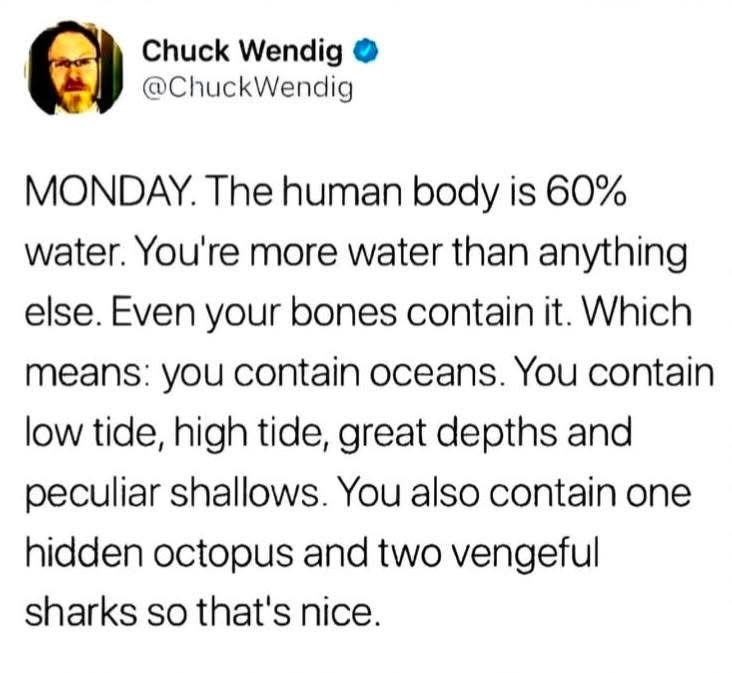
And lest we forget, water is in us as well. Jiggly with organs. Reaching out with every scratch. Vibrating with every emotion. The body is sixty-ish percent water, and I love how Chuck Wendig elaborates on this statistic in this social media post:
Editorial: The Collection

“You’re more water than anything else. Even your bones contain it. Which means: you contain oceans. You contain low tide, high tide, great depths and peculiar shallows. You also contain one hidden octopus and two vengeful sharks so that’s nice.”

This month, we explore those peculiar shallows. We have a bog in “Lizzie Williams’ Swampy Head” by Joshua Jones Lofflin, and a flooded shrine in “Drown-Haunted” by Corey Farrenkopf. We have an aquarium in “The Chaperone” by Kimberly Crow.

We have menacing sea creatures, both in “The Qalupalik” by Shantell Powell, as well as in “Borrowed Breath and Starlit Scales” by Erin L. Swann.

But to start us off, we have a not-so-hidden octopus in “Henrietta Armitage Doesn’t Read Anymore” by Damon Young. It peeks out at the world, sometimes controlling Henrietta, sometimes defending her.

I still wear my octopus pendant when I want to feel safe, when I need to be crafty or cunning, when I need eight arms to handle all the leaks. I’ll go put it on right now and maybe the water molecules in me and around me will help connect me to all of you.

* * *

Rebecca Halsey

Leave a Reply

Henrietta Armitage Doesn’t Read Anymore

by Damon Young

March 7, 2025

Content Warning: suicidal ideation

Henrietta was light-headed. The old man slouching across from her had a sardine sandwich, so the waiting room reeked. Henrietta’s octopus enjoyed the stink, but she herself was nauseous. That’s why she was there: the dizziness, the hot bile, the drool.

She turned to the girl beside her, green fringe poking from her pilling hoodie. Whispered: ‘Who eats in a doctor’s surgery?’

‘Huh?’ Pulled one earphone out.

The old man was looking at her now. Tongue moistening his lips. Sauce on his bone-coloured shirt.

‘Never mind.’

Henrietta busied herself with her phone. The octopus liked a story about Greek whitebait.

‘Henrietta Armitage?’ The doctor was small and neat, wearing a buttoned-up dress decorated with smiling seals. The octopus did not like this. ‘Come through, Henrietta.’

* * *

The doctor’s surgery had framed certificates on the wall, next to photos of children and mountain peaks. A physician. A parent. And a hiker. You wouldn’t find her feeling faint and retching on the commute.

‘Henrietta. That’s an interesting name.’

‘My parents were nerds.’

‘I love it,’ she said with enthusiasm. Then, perhaps because the enthusiasm was too much: ‘My name’s so boring. Samantha. Sam. Sammy. I always wanted an exotic name.’

‘I always wanted to take the bus without vomiting,’ Henrietta said with a laugh, then realised it came out awkwardly.

‘Right then.’ No smile now. The doctor leaned away from her. ‘Is that why you’re here today? Persistent nausea?’

‘Yeah. Mostly on the way to work, but then I don’t really go anywhere else. Except here.’

‘What do you do, Henrietta?’

‘I work in a bookshop.’

‘Heaven.’

‘Not really. It’s mostly talking to customers and lifting boxes. Or standing at the till, looking busy.’

‘But you get all the best books first.’

‘I don’t read any more.’ The octopus played with the doctor’s ballpoint.

The doctor took her pen back and made notes, tongue in the corner of her mouth. ‘This nausea. Do you think it might be that octopus in your skull?’

Henrietta laughed.

The doctor laughed too, but only politely. ‘I’m serious, though. I can see the tentacles coming out of your mouth and nose. That might be making you sick.’

Henrietta’s mouth widened. ‘I don’t know what you’re talking about.’

The doctor took down a thick book from her shelf. Flipped through, humming. Then pointed to a diagram: ‘If your octopus is pressing on here or here, that could certainly be causing your sickness.’

Henrietta brushed a tentacle away and rubbed her eyes. ‘Doctor, it’s not a real octopus. It’s a metaphor. You can’t get sick from a metaphor.’

‘And yet,’ the doctor said. ‘Here you both are.’

She shouldn’t have come here. She should’ve stayed safe, behind closed doors and blinds. She should’ve—

‘Enjoy your books,’ the doctor said, handing her a light blue prescription slip.

The octopus tugged at the door handle.

* * *

The bus trip over the bridge was always the worst part. Henrietta started to salivate, but not from hunger. Things began to turn. And faster.

The octopus began singing.

There was no getting off now. The next stop was across the river.

Henrietta breathed to stop the faintness. Thick rose perfume. Dim-sims. Wet shorts. Air in, air out. A tentacle slid along the window.

She looked away from the water, but it was no good. The octopus knew it was there. And the octopus wanted nothing more than to dive in; to cool its blue blood in the deep, then crawl under sharp rocks. 

‘You okay?’ The woman next to her wore large sunglasses and a mask with daffodils on it. Her voice was phlegmy.

‘Fine, thanks. Fine.’

The octopus put all its tentacles to the glass. Rattled the pane. Harmonised with itself, the notes low.

Henrietta licked the window. What a promise it was: of all things quiet and calm and cold. The joy of leaping and falling and giving up the glare; of thin cracks and deep sand and never having to be witnessed as anything other than a dark shape among dark shapes.

‘I’ve got some pills that’d sort you out.’ The woman took a plastic container from her bag and shook it.

The octopus threw it to the floor.

The woman made a shocked face to the other passengers. ‘The fuck’s wrong with you?’

‘I’m so sorry,’ Henrietta panted. ‘It’s my metaphor.’

Red light. The container rolled to the front of the bus.

Green light. The container rolled back. The woman snatched it up. ‘Fucked in the head.’

The octopus pulled at Henrietta’s eyes, showing her the waves. And below the waves. The thrill of the anonymous gloom. The heavy, holding water. The gentle currents.

‘Yes,’ Henrietta said to the deep, swallowing her spit. ‘Yes.’ Then stood up.

The woman pulled down her mask: ‘Driver! Driver!’

Crescendo. The octopus’s abdomen pulsed, shuddered.

Henrietta reached for the door.

‘Next stop,’ the driver said. ‘Next stop.’

The doors opened to the bright, dry world.

* * *

The octopus felt stiff now, like its organs were attached to ligaments, and these ligaments to bones. 

The biped kept it fed with delivered food. And her room was comfortably dim: the blinds always closed, the lights dimmed. 

But the octopus needed more: colder, darker, deeper days. It trailed a tentacle along the window’s condensation, then let it drip to its beak.

Her phone buzzed. The biped stirred. ‘Yeah?’

‘We need you at the shop today, babe.’

The bridge. The drop. The water, pressing, pressing, pressing.

‘I’m sick.’ The biped stared at a crumpled square of light blue paper.

‘Everyone’s sick.’

The biped’s finger moved over the red button. The octopus slapped at her hand.

‘I’m sorry. I just can’t. Maybe next week.’

‘You can come in today, babe. Or not at all.’

The biped rubbed her eyes. ‘Isn’t there some magical third thing?’

‘Magical third things are only in books, babe.’

‘I don’t read any more.’

‘Yeah, me neither. I’ll drop over the keys.’

The biped’s face became wet, the octopus sipped.

* * *

Damon Young

Comments

  1. This is so unusual .Lovely read beautifully descriptive.

Leave a Reply

Lizzie Williams’ Swampy Head

It was during those months of strangling, watery heat when Lizzie Williams first told us about the head. She kept it in a burlap sack and would walk everywhere with it slung over her shoulder. When she grew tired, she let it bump along behind her in the rusty dirt. It don’t mind, she told us. It’s just a head.

A penny would get you a peek. A nickel a good look, just long enough to squint at the shadowed features. Some saw a freckly boy. Others a wrinkly old woman. Junie Lee said it was nothing but a dirty skull, but she was dirty herself and nobody paid her any mind. Ida Wallace shouted, It’s smiling at me, then Lizzie Williams snapped the sack shut and said the good look was over, even though it hadn’t been five mississippis and she knew it.

A dime, she said, and it’ll answer a question.

Any question? I asked and fished out the coin I’d snuck from my mama’s bingo jar.

Anything, Lizzie lisped through snaggled teeth, but there, in the fading light behind the school, all I could think to ask was where it came from. Then the sack’s shadowy folds stirred, and a croaking voice said, The swamp.

Dawn Macy said I was stupid to ask such a dumb question. Where else would swampy Lizzie Williams get such a thing? Lizzie, who brought baby gators to school. Lizzie, whose hair smelled like spoiled turtle eggs. Lizzie, who now skipped off to the snake-ridden hollow where she and her pappy lived, her pockets jingle jangling with coins. She hummed a song as she went, an I-got-all-your-money tune.

The next day, she met us beneath the monkey bars with an icy Coca-Cola in one hand and the sack dragging behind her. The sun glowered overhead as she slurped her soda through a paper straw. Don’t be sore, she told us then said the head could tell us secrets, as long as we told it one first. She set up a confessional in the janitor’s tin-roofed shed, beneath strange silhouettes of shovels and rakes and claw-like shears. We lined up outside and wondered what kind of secret Fannie Miller must be spilling to be taking so long; we laughed when Sue-Ann Phelps came out all quick and blushing; we grew quiet when Junie Lee emerged, her shoulders drooping more than usual. When it was my turn, the head’s sooty eyes bore into me until I blurted out my darkest secret, forgetting to be quiet, forgetting that Lizzie was right there, her smile stretching wider and wider like a frog. The head whispered its own secret back, its voice harsh as lye, its breath like rotting peat.

We didn’t share the secrets the head told us but eyed one another crookedly beneath the day’s heavy heat. Finally, Lizzie Williams came out saying it sure was hot and she could do with another Coke. Then she skipped along, the sack bouncing over her shoulder. Through a tear in the sack, the head stared at us. Some of us said it winked.

I hate that head, Dawn Macy said, though we knew she didn’t mean it. The first thunder of the day rolled across us, and we watched clouds billow up and waited for the sky to darken, waited for Lizzie Williams to come past with another Coke. She had all our soda money and all our secrets and we had nothing. One of us, and we can’t agree on who, said we should get a head of our own.

So that’s how we came to follow Lizzie Williams to her and her pappy’s place. We carried shovels and spades for digging, hatchets and sling blades for cutting through thickets of palmettos. It was growing dark beneath the live oaks’ black, oily leaves, and soon the rain would pelt us hard.

Lizzie lived in a small, squat shack that leaned to one side, its front porch half fell-off already. She was inside, lighting a lantern; in the dark of the shack, her head bobbed about from window to window. There was no sign of her pappy. The yard was weeds and sand, and our tools were sharp; soon we’d dug head-sized holes all across it, sometimes crying out when we thought we hit something. We must’ve carried on like that for about an hour as the sky grew tighter about us, until Lizzie Williams sauntered onto her porch and demanded to know what all the commotion was. She cradled the head in her arm like a baby. It was even uglier out of the sack. It grinned as she spoke.

Get on out of here. My pappy will have a fit if he sees y’all messing up our yard.

We want ourselves a head, Lizzie Williams, we said.

There’s just the one, and it’s mine. Lizzie hopped down from her porch and told us all to scram. Heat lightning rippled across the clouds and a flurry of nightjars took flight.

We told her we knew there was another head, and we aimed to dig it up, and she better tell us where it was.

There ain’t no more heads, she said, and the wicked thing in her arm wheezed out a laugh like the sawing of cattails.

We called her a liar. Said there had to be another one. Ask the head, we cried, and she did, while we leaned on our shovels and sharp spades and waited for the head to answer in its raspy, smoky voice:

There’s another head.

And it laughed. And we looked round. And thunder split the sky. And Lizzie Williams looked at us and our tools with her round, round eyes in her round, round face. And she said, What y’all staring at? And the head laughed some more. And the rain, it finally let go.

* * *

Joshua Jones Lofflin

Originally published in MetaStellar, May 2021. Reprinted here by permission of the author.

Leave a Reply

The Qalupalik

by Shantell Powell

March 14, 2025

Content Warning: child endangerment

The qalupalik waits in the icy shallows, just the other side of a big boulder. She wears an amautik, the coat of mothers, and its big wolverine-trimmed hood hides her slimy green skin and kelp-like hair. She hums to herself as she waits. If she is patient, children will come to her. 

Arctic char fingerlings swim around her ankles, but these don’t interest her. Purple-shelled mussels cling to her legs, and every now and then, she plucks one, cracks the shell with her long fingernails, and picks at the orange flesh with teeth worn-down by chewing countless skins. She smacks her tongue then hums some more.

On the other side of a hill, an anaana warns her children yet again. “Don’t stray too far,” she says. “Don’t go near the water or the qalupalik will get you.”

And in the icy shallows, the humming call comes higher now, the buzz resonating in the qalupalik’s nose. She gets her answer. From off in the distance comes the sound of giggling. Two disobedient children run toward the shore carrying little harpoons, looking over their shoulders to make sure they haven’t been seen. They should know better than to sneak off. They should’ve listened to their anaana, but here they are, instead. Just where the qalupalik wants them. They squat down on the rocky beach looking for smooth pebbles and rare pieces of driftwood beneath a silver crust of salt frost, and the qalupalik hums more loudly.

“What’s that?” asks the girl. She wears a caribou and sealskin parka. Her cheeks are red from the bitter wind and she is still too young for any tattoos of accomplishment. 

“What’s what?” says the boy. He wears his charms around his neck. His eyes squint as he looks out across the water. An iceberg rolls over like a dog and shows its blue belly beneath the low-slung sun.

“That humming sound.”

“I don’t know,” says the boy. “Let’s find out.”

And so they skip from rock to rock, moving their way further from the safety of the shore. Tube-nosed fulmars shriek and take to the air. Their wings flash like the white-tipped surf. The qalupalik shivers, anticipating, clacking her fingernails in rhythms on the rock. She hums lower now in a polyphonic drone simultaneously high and guttural. It comes from deep in her throat. It comes from high in her head.

“It’s over here!” says the little boy, and he clambers atop the boulder slick with seaweed.

“Is it a seal?” asks the girl, climbing up after him. If they harvest a seal, their ataata will be pleased.

The boy leans forward, and his big sister catches his parka so he doesn’t slip. “No, it’s a—”

On the other side of the rock, the qalupalik grows. Quick as the darkness when a fire goes out, the qalupalik grabs. She pounces upon them before they can scream. Though they squirm and fight like the young pups they are, her arms are quicker, still. And once she has them, they do scream. Like a diving seal, she closes her ears to the sound. The wind carries their cries for help out to sea, but it does not carry them to their anaana. From afar, they sound no different than seabirds. The qalupalik forces first one then the other into the fur-trimmed hood of her amautik. She tucks them down her back and wades out toward the frigid channel. 

“No,” cries the little boy. He regrets not listening to his anaana. He does not want to be carried to the bottom of the sea. He struggles to find his way out of the hood as the water deepens and the land grows further away.

But the little girl remembers a story. “You!” she says, addressing the qalupalik. “I heard you can change shapes, but I don’t believe it.” She looks at her brother meaningfully.

The qalupalik pauses. She dislocates the vertebrae of her neck, turns unnaturally far to look at the children. Her neck vibrates like collapsing ice. Her round eyes bulge like guts from a slit belly.

“Yeah,” says the boy. “I’ll bet you can’t turn into a seal.”

“Anyone can turn into a seal,” says the little girl. “Anyone except you.”

The qalupalik growls. The qalupalik turns her head back around and the movement cracks and snaps like breaking bones, and then she sheds her amautik. Its waterproof hood floats in the sea like a qajaq with the children dry inside. She stands naked in the water, skin as blue-green and slick as ice algae. Her long eel-like breasts writhe upon her belly. She grunts and groans, and the skin of her head splits. Out from it protrudes the sleek face of a ring seal, whiskers twitching, nostrils opening and closing. She rumbles and squeaks with the effort. While she is still emerging from the body of the qalupalik, the children thrust their harpoons straight into her nose.

The slate and bone tips lodge inside her brain. The qalupalik judders as she dies. 

When the children pull the dead seal to shore, the boy melts snow in his mouth and dribbles it onto the qalupalik’s cooling tongue. A fair trade of fresh water for a life given. All seals are gifts from Sedna and must be honoured thus. 

The girl growls deep in her throat. Sings high in her nose. Repeats the green woman’s song. She has earned her first tattoo. The flock of fulmars returns to the shore to scream and bow to one another.

* * *

Shantell Powell

Comments

  1. AF says:
    That’s incredibly evocative and tense. Love it.

Leave a Reply

The Chaperone

by Kimberly Crow

March 18, 2025

Content Warning: infertility

In front of Ashanti and behind thick glass, blue-ringed angelfish darted around the tank, which stretched along an entire wall of the aquarium. A turtle glided into view and then disappeared around a coral reef. Sea anemones flailed their whorls of tentacles, reminding Ashanti of the tails of sperm trying to penetrate an egg. 

The room echoed with high voices as elementary school children pressed their oily fingers against the glass and pointed out floating turds to their friends. She tuned them out, focusing instead on the vastness of life undulating before her, the colors so bright, they were almost hostile.

“Did you know a group of bass is called a shoal?”

Ashanti looked down at the bespectacled boy, wearing a school-mandated field trip t-shirt. His was a few sizes too big, his thin arms shooting out of the sleeves like popsicle sticks.

“And that a bunch of ferrets is called a business? And a swarm of gnats is called a cloud.”

“You don’t say?” said Ashanti.

At her appointment earlier at the neighboring clinic, she had learned a stream of other terms: diminished ovarian reserve, laparoscopy, Clomid, endometrium.

Before she could ask the boy if he knew the name for a group of cells on the outside layer of an ovary, he skipped away across the room to where eels stretched in and out of shadows. She moved to the next exhibit, marveling at the perpetual activity in each tank.

Downstairs, squealing with each bray of the penguins, the students struggled to listen to the aquarium staff educate them about penguin lifespan, diet, and habitat conservation. Ashanti felt a tug on her arm. The same boy as before held a clump of her sweatshirt in his fist, a bag of chips in the other.

“Here,” he chimed, hovering the half-eaten snack in her face.

Ashanti looked up to see a dotting of chaperones – parents, no doubt – nervously eying the kids, a few silently counting heads. Many balanced piles of belongings in their arms—discarded coats, crumpled notebooks, hats. One leaned over and asked Ashanti if she, too, was counting down the minutes until the bus ride home.

Ashanti smiled, unsure how to answer. She wondered what a group of adults who didn’t know how good they had it might be called. A spoiling?

The woman lingered. “Which one is yours?”

An ache burned deep in Ashanti’s belly. She darted her eyes around the hall, not wanting to be accused of creeping. “Um, the short one over there.” She indicated a cluster of indistinguishable children chasing each other in circles. The woman nodded and pointed out a chubby-cheeked girl in striped tights and Paw Patrol sneakers, adding, “They grow up so fast.”

When the teacher started to usher out the crowd, Ashanti held back, pretending to check for forgotten items. There was a spot of grease on her sleeve from where the boy had grabbed her. She gently touched it and then reached for a chip. She made a kissing noise, calling to the flightless birds. Then, even though she wasn’t supposed to, she tossed them some food like they were her own.

* * *

Kimberly Crow

Originally published in WOW! Women on Writing, May 9, 2024. Reprinted here by permission of the author.

Comments

  1. Jen Shepherd says:
    Loved this essay. Beautiful and well written.
    1. Kimberly Crow says:
      Thank you, Jen 🙂
  2. AF says:
    Absolutely wonderful. Thank you.
    1. Kimberly Crow says:
      Thank you so very much for reading, AF!
  3. Stephen Cote says:
    Nice work. Good story. Glad you’re still writing.

Leave a Reply

Drown-Haunted

by Corey Farrenkopf

March 21, 2025

Content Warning: parental death

My mother had a shrine to God in the basement before the flood came. Candles. Statuary. The golden tabernacle. Stained glass looked out on concrete foundation, no portal to a drier world. She’s still down there, bones picked clean by river fish, snapping turtles risen from swamps. She thought prayer would save her, an invisible, tide-halting dome cast over the house. I’ve seen her hollow, skeletal remains. A scuba mask and snorkel borrowed from a neighbor.

The other version of her sits on the roof, ghost shimmer radiating off translucent skin, eyes black, flood waters lapping at gable ends. The men and women who once lived in town drop anchor at the house’s edge, asking for mother’s blessing. No other house is drown-haunted. The rest of the neighborhood is abandoned.

I tie up to a leafless tree, life sucked from bark-shorn trunk.

We weren’t close those last years, but I’ll never forget the shrine, the childhood hours spent kneeling at the foot of God, Their wings of bleached marble, Their dozen eyes staring into my soul, weighing sins.

“My husband, he’s got the Cough,” a woman says once her outboard chokes silent.

“My boy, the Mold is in his blood,” another says.

“My wife, she sees the Man Who Isn’t There. He says things to her, asks her to follow. I need Him gone. I need…”

My mother looks at each, draws the Circle in the air, and motions to the horizon. She rarely speaks, regardless of offering. Hunks of meat and polished stone, small statutes mimicking those drowned beneath the house, foxed paperback copies of romance novels she once bought from the grocery store.

I heard enough boat-spread rumors. Waterlogged gossip.  How their boy recovered. How the Cough dried. How the Man stopped speaking to the wife, no longer offering his hand to that other world.

Not everything could be healed, but most she managed.

Prayers hadn’t saved mom, but they saved something in her, dead undying. And I needed that something, because, like everyone who visits, I too need something. But I told myself I’d never ask her for another thing. But that was when she still drew breath. When I was still young. When my own son was free of the Mold that colonized the young.

I’d come at the end of days and watch. The words passed, outboards churning, Circle drawn again and again.

Then I steer my skiff home, to the raised rooms where my son slumbers, eyes fever-fluttered, the mottled green growth crawling over his chest, dancing in his fingertips.

I repeat the trip, marking the path like a pilgrim to a temple. I know the prayers. She’d etched them into my gray matter, laying each down like steel bars over gaping windows. Indoctrination is a hard hawk to vanish.

The sun rises.

The sun sets.

When the creeping growth creeps up his neck, there is no waiting.

She smiles when she sees me at the roof’s edge, black eyes cast over us, tongue wandering lips. Something stirs behind her teeth, but I can’t name what. My son lies in the bow, head lolling against the gunnel.

“You know I wouldn’t come unless I needed to,” I say.

“Son?” she asks, nodding, pointing to my son, his face almost identical to hers.

“Yes.”

“Sick?”

“Also yes. Can you…”

“For bones.”

I don’t know what she’s asking.

“For bones,” she says again, pointing below, through water, through the house. I’ve never heard her ask anything of anyone, no bartering for miracles.

“Really?” I ask.

She nods and points at my son.

I understand.

The goggles and snorkel are in the center compartment. I tighten the adjustable strap around my head, rubber mouthpiece between lips. I tell my son I’ll be back, then lower myself into the water. It’s warm, like everything is warm.

The door to my childhood home is torn away, the threshold a gaping maw. I swim inside, kicking, hands pulling me through the water to where basement steps descend. The filtered light is yellow and green dripping through blown-out windows. As I drop lower, light fades to a sickly gray, only the smallest slits for foundation windows. It isn’t much, but it’s enough to see the shrine, God’s marble wings coated in algae, the once polished tabernacle tarnished, tiny fish swimming in and out of their shrunken architecture. And she is there, where I last saw her, skull face down at the foot of the shrine, ribcage coated in snails. I gather what I can, tibia and fibula and pelvis, and kick back to the surface, drifting through our old living room, our drowned kitchen. I deposit what I carried into the boat before diving again, repeating the process until all of my mother is retrieved.

“That’s everything,” I say.

She nods and draws the Circle in the air, over my son, over me.

“Is that it?” I ask.

She nods. “Take them.”

“Your bones?”

She nods again. “With you.”

As she speaks, I can already see the Mold receding over my son’s flesh, skin reverting to the paleness of youth.

“Why?” I ask.

“Penance,” she says.

As I start our engine and steer us away, I almost expect my mother to float out over the water, following in our wake. But she stands there, at the edge of our roof. I wave. She doesn’t wave back.

Some things never change.

Some things do.

Her bones rattle in the bottom of the boat, ready for a new shrine, a new home.

* * *

Corey Farrenkopf

Comments

  1. Erin says:
    Oooo, Spooky and refreshing 🙂 Every line of this was kind of surprising and mysterious, it felt like there were so many direction to explore. A lot of fun to read!

Leave a Reply

Borrowed Breath and Starlit Scales

by Erin L. Swann

March 28, 2025

Fantasy

“One of these days, you’re going to kill me.”

“I know,” she murmured, breath brined with salt and green weed. Her eyes held mine, inhuman and unfeeling, slitted and narrow, yet they drew me in. I never welcomed the chill of midnight on the water until I met her. She froze my bones with her predatory gaze, thrilled goosebumps up my arm with a touch. Otherworldly. Dangerous. The exhilaration of floating at death’s door addicting.

“Come.” Her webbed hand was slick with moonlight and she reached out of the lapping waves, beckoning me to ride them.

I was already halfway into her embrace and I fell over the side of my sailboat, plunging into her domain. Despite having done this enough times to lose count, I still inhaled as the sea shocked my body. But my limbs were rigid only for a moment before she was there beside me, oil upon the water, separating me from the dangers of the depths.

I faced the danger of her instead.

Her grip iron tight on my arm, she dragged me along as no undertow could and I relished every flash of jeweled scales and sway of her weeded tresses. We raced selkies that danced like liquid lightning, riding in their wake long after they left us behind. We leered at fleshy pink of nereids and she swiped one of their coral combs for my hair.

When my lungs burned hot enough to melt the ice in my veins, she would turn and press her lips to mine, exhaling and filling me with frigid breath. Nothing tasted as clear and crisp as her.

Hours after my body grew blue and I forgot I once had legs, we laid among glassy rocks that cut above the surface of the waves. I told her tales of flaxen forests and sweet cornfields laden with gold, and her silken laughter licked me head to toe.

“Stay.”

“I can’t.”

“You can.” Her hand slithered to the back of my neck, pulling me to stare into her eyes again. “You can.”

As I readied my usual arguments, I paused, reading a plea in her gaze I hadn’t before. A plea that mirrored my own.

I thought of my weeks pacing the shore, dreaming of the next time the moon was full. When we would meet to steal starlight off the backs of whales and kiss silver foam each time we crested the tide.

The bright days at home with family, filled with freckled apple-cheeks swelled with smiles, were empty now. Names and places I used to know and love paled in comparison to her steel-tipped smirk, the way her voice oozed through me, misting my thoughts.

What was the point of my life if I lived only for these brief moments? A phantom hovering at the edge of the water, already dead to that world of lambent warmth.

I breathed out, relinquishing the hold of the shore, of sandy grit dry between my toes, of laughter and scorching sun.

“I can.”

Her smile slaked through my blood, glacial and bitter. I felt the spark of life sputter within my chest.

It was the end of me.

But it was the beginning of something else.

* * *

Erin L. Swann

Originally published in Factor Four, October 2022. Reprinted here by permission of the author.

Leave a Reply

Henrietta Armitage Doesn’t Read Anymore

by Damon Young

June 5, 2025

Literary

I have a collection of octopuses. There’s probably an octopus in every room of my house, a tentacle waving at me from every doorway. I haven’t always collected them—I didn’t know anything about the animal as a kid. I’m mildly concerned about what a large collection of anything suggests about the collector. But there was no checking the accumulation of tentacles once it began in college.

I have a collection of octopuses. There’s probably an octopus in every room of my house, a tentacle waving at me from every doorway. I haven’t always collected them—I didn’t know anything about the animal as a kid. I’m mildly concerned about what a large collection of anything suggests about the collector. But there was no checking the accumulation of tentacles once it began in college.

I have a collection of octopuses. There’s probably an octopus in every room of my house, a tentacle waving at me from every doorway. I haven’t always collected them—I didn’t know anything about the animal as a kid. I’m mildly concerned about what a large collection of anything suggests about the collector. But there was no checking the accumulation of tentacles once it began in college.

I have a collection of octopuses. There’s probably an octopus in every room of my house, a tentacle waving at me from every doorway. I haven’t always collected them—I didn’t know anything about the animal as a kid. I’m mildly concerned about what a large collection of anything suggests about the collector. But there was no checking the accumulation of tentacles once it began in college.

Leave a Reply

Join the 
Community

Support

Become a member of our Patreon community

Subscribe

Subscribe via Weightless Books

Submit a Story

Submit your story using our Submittable portal